

Alongside Armstrong was Buzz Aldrin, an astronaut, engineer, fighter pilot, and scientist whose work played an important role in one of humanity’s most remarkable achievements. On July 20, 1969, Aldrin became the second human to walk on the Moon after Armstrong, while Michael Collins remained in lunar orbit aboard the command module Columbia.
What makes Buzz Aldrin particularly interesting is that his contribution to space exploration began long before he stepped onto the lunar surface. His education, military career, work on orbital rendezvous, and Gemini missions all helped prepare him for Apollo 11.
Even decades after that historic mission, Aldrin remains closely associated with the future of human space exploration.
Who Was Buzz Aldrin?
Buzz Aldrin was born Edwin Eugene Aldrin Jr. and became one of the most recognizable astronauts in history.
Before joining NASA, he built an impressive career in engineering and military aviation. He graduated from the U.S. Military Academy at West Point with a degree in mechanical engineering and later earned a doctorate in astronautics from the Massachusetts Institute of Technology.
His doctoral work focused on orbital rendezvous techniques, an area that would become extremely important during the development of human spaceflight. NASA notes that this work contributed to his nickname, “Dr. Rendezvous.”
Aldrin was selected as part of NASA’s third group of astronauts in 1963. Unlike some astronauts of the era, he entered the program with a doctorate, combining military experience with advanced technical knowledge.
That combination would become one of his greatest strengths.
Buzz Aldrin’s Early Life and Military Career
Long before the Moon landing, Aldrin had already experienced the demanding world of military aviation.
He served as a fighter pilot during the Korean War, flying combat missions and receiving military decorations for his service. His experience as a pilot gave him practical knowledge that would later prove valuable in the highly technical environment of NASA.
But flying was only one part of his background.
Aldrin was deeply interested in the mathematics and mechanics behind spacecraft movement. His doctoral research at MIT examined how spacecraft could rendezvous in orbit, essentially finding ways for two spacecraft to meet and operate relative to one another in space.
Today, orbital rendezvous may sound like a standard part of spaceflight. At the time, however, it was a major challenge.
NASA’s Gemini and Apollo programs depended on solving these kinds of problems.
Why Orbital Rendezvous Was So Important
One of the less obvious parts of the Apollo story is that landing on the Moon was only half the problem.
NASA also had to figure out how astronauts and spacecraft could operate safely in lunar orbit and return home.
Rendezvous and docking techniques were therefore essential.
Aldrin’s work helped advance the understanding of orbital rendezvous, and his technical expertise became part of the broader foundation on which NASA’s Gemini and Apollo missions were built.
This is an important part of his legacy because it shows that space exploration isn’t created only by dramatic moments.
Sometimes the most important work happens years earlier, inside calculations, simulations, training sessions, and engineering studies.
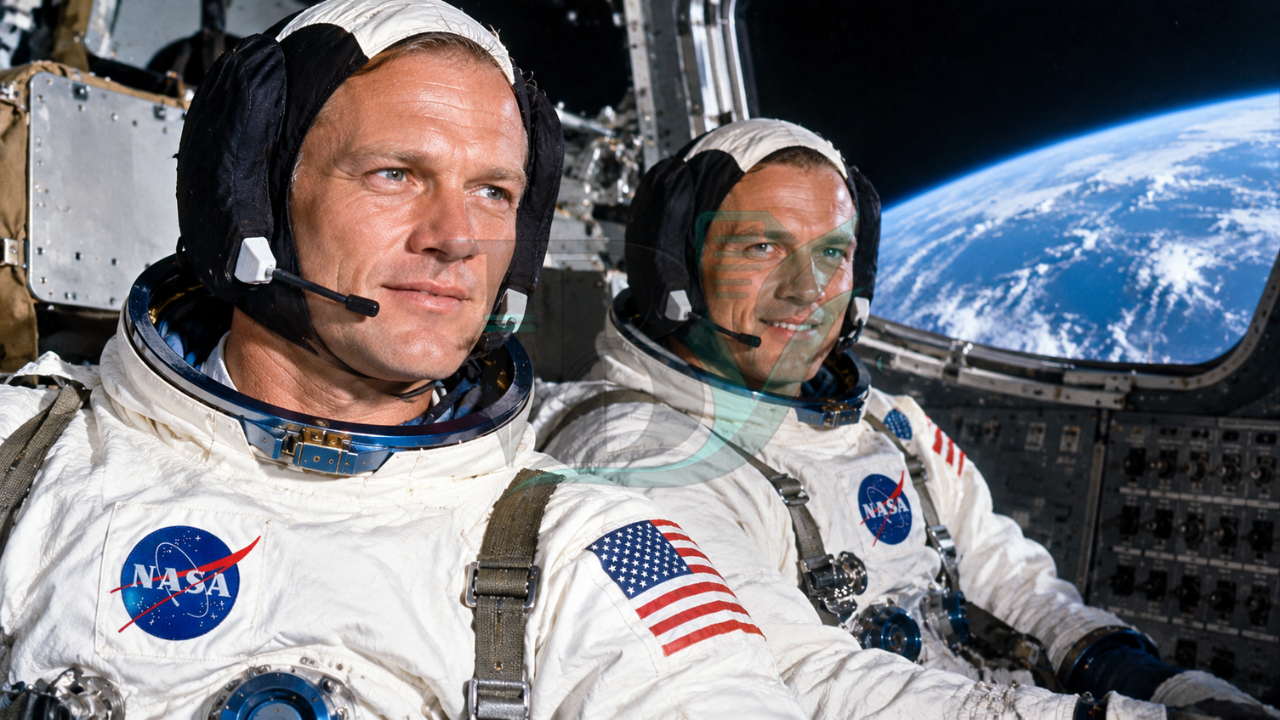
Buzz Aldrin and Gemini 12
Before Apollo 11, Aldrin had already been to space.
His first spaceflight was Gemini XII, which launched in November 1966. He flew the mission with astronaut James Lovell.
Gemini XII was the final crewed flight of NASA’s Gemini program and served as an important stepping stone toward Apollo.
Aldrin performed multiple extravehicular activities during the mission. NASA’s astronaut records credit him with two spacewalks totaling 7 hours and 52 minutes across his career.
His Gemini experience was particularly significant because astronauts were still learning how difficult work outside a spacecraft could be.
Early spacewalks had revealed problems involving fatigue, body positioning, and the ability to perform useful tasks while wearing a pressurized spacesuit.
Aldrin’s preparation and performance helped demonstrate better ways to train for extravehicular activity.
Buzz Aldrin’s Journey to Apollo 11
After Gemini XII, Aldrin moved into the Apollo program.
In January 1969, NASA officially announced the crew for Apollo 11:
| Apollo 11 astronaut | Role |
|---|---|
| Neil Armstrong | Commander |
| Michael Collins | Command Module Pilot |
| Buzz Aldrin | Lunar Module Pilot |
Each astronaut had a specific responsibility.
Armstrong commanded the mission and ultimately piloted the lunar module during the landing.
Collins remained in lunar orbit aboard Columbia, responsible for the command module while his crewmates descended to the surface.
Aldrin served as the Lunar Module Pilot and accompanied Armstrong to the lunar surface.
That division of responsibilities was critical. Apollo 11 wasn’t simply a trip to the Moon; it was an extremely complicated operation involving multiple spacecraft, precise navigation, communications, scientific equipment, and carefully timed procedures.
The Historic Apollo 11 Moon Landing
Apollo 11 launched on July 16, 1969, from Cape Kennedy in Florida.
The crew traveled approximately a quarter of a million miles to the Moon before entering lunar orbit. On July 20, Armstrong and Aldrin descended toward the lunar surface in the Lunar Module Eagle while Collins remained in orbit.
The landing itself became one of the defining moments of the 20th century.
Armstrong stepped onto the lunar surface first.
Aldrin followed shortly afterward, becoming the second human to walk on another world. NASA records that Armstrong and Aldrin spent roughly 2½ hours exploring the lunar surface during their extravehicular activity.
They collected lunar samples, photographed the surface, deployed scientific equipment, and carried out various mission tasks.
The pair eventually returned to the Lunar Module and lifted off from the Moon to rendezvous with Collins in lunar orbit.
It is easy to remember the landing as a single dramatic moment. In reality, it represented years of engineering, training, testing, and teamwork.
The Famous Buzz Aldrin Moon Photograph
One of the most recognizable photographs in the history of space exploration features Buzz Aldrin standing on the lunar surface.
The photograph was taken by Neil Armstrong during the Apollo 11 moonwalk. Aldrin is seen near the Lunar Module, with the lunar landscape extending behind him.
The image became more than just a photograph of an astronaut.
It became a visual representation of humanity’s first steps on another world.
Interestingly, Armstrong himself appears in very few photographs from the lunar surface because he was frequently operating the camera while Aldrin was being photographed.
That is one reason the famous image of Aldrin has become so strongly associated with the Apollo 11 mission.
What Did Buzz Aldrin Do on the Moon?
Aldrin’s job wasn’t simply to walk around and take photographs.
He and Armstrong had a busy schedule on the lunar surface.
Their activities included:
- Collecting lunar rock and soil samples
- Photographing the lunar environment
- Deploying scientific equipment
- Examining the area around the landing site
- Carrying out mission experiments
- Documenting their activities for scientists and engineers on Earth
NASA states that the astronauts collected 47 pounds of lunar surface material during their approximately 2½-hour surface exploration.
The scientific value of these samples would extend far beyond the mission itself.
Researchers could study material that had never naturally existed on Earth, helping scientists better understand the Moon’s geological history and the early solar system.
Buzz Aldrin After Apollo 11
Apollo 11 made Aldrin internationally famous, but his career did not end when he returned from the Moon.
He eventually left NASA and the Air Force in the early 1970s. NASA records state that he resigned from NASA in July 1971 after logging almost 290 hours in space, including nearly eight hours of spacewalking.
Life after Apollo wasn’t always easy.
Aldrin later wrote about the challenges that came with returning from an extraordinary mission and suddenly becoming a global celebrity. His memoir Magnificent Desolation explores his experiences after Apollo 11 as well as his personal struggles and later efforts to move forward.
Instead of disappearing from public life, however, Aldrin continued to advocate for human exploration of space.
Buzz Aldrin’s Vision for Future Space Exploration
Aldrin’s interest in space has always extended beyond the Apollo era.
He has repeatedly promoted the idea that humanity should think beyond simply returning to the Moon. His work has included advocacy for future human missions and long-term exploration.
This is an interesting part of his legacy.
Buzz Aldrin isn’t remembered only because he walked on the Moon. He is also remembered because he continued asking a bigger question:
Where should humanity go next?
That forward-looking attitude has helped keep his name relevant long after Apollo 11.
Awards and Recognition
Aldrin received numerous honors during and after his NASA career.
Among them was the Presidential Medal of Freedom, which he received in 1969 along with his Apollo 11 crewmates. NASA also lists other major awards including the Robert J. Collier Trophy, the Robert H. Goddard Memorial Trophy, and the Harmon International Trophy.
His educational achievements are equally notable.
NASA records his doctorate in astronautics from MIT, while his earlier education at West Point gave him the engineering foundation that supported his military and astronaut careers.
Why Buzz Aldrin Still Matters Today
It can be tempting to think of Apollo 11 as history that belongs entirely to the 1960s.
But Aldrin’s story remains relevant because many of the questions surrounding space exploration have not disappeared.
Humanity is still working on:
- Returning astronauts to the Moon
- Developing sustainable lunar exploration
- Improving spacecraft technology
- Preparing for deeper-space missions
- Understanding how humans can live and work away from Earth
Aldrin’s career demonstrates how different disciplines can come together.
He was a pilot, engineer, astronaut, researcher, and advocate for exploration.
That combination is part of what makes his story so compelling.
Frequently Asked Questions About Buzz Aldrin
Who is Buzz Aldrin?
Buzz Aldrin is an American astronaut, engineer, and former fighter pilot who became the second person to walk on the Moon during the Apollo 11 mission in July 1969. He served as the Lunar Module Pilot alongside Neil Armstrong and Michael Collins.
When did Buzz Aldrin walk on the Moon?
Buzz Aldrin walked on the lunar surface on July 20, 1969, during the Apollo 11 mission. Neil Armstrong stepped onto the surface first, followed by Aldrin.
What was Buzz Aldrin’s role on Apollo 11?
Aldrin was the Lunar Module Pilot. He descended to the lunar surface with Neil Armstrong aboard the Lunar Module Eagle, while Michael Collins remained in lunar orbit in the command module Columbia.
Did Buzz Aldrin go to space before Apollo 11?
Yes. Aldrin’s first spaceflight was Gemini XII in 1966, which he flew with James Lovell. The mission was the final crewed flight of NASA’s Gemini program.
Why was Buzz Aldrin called “Dr. Rendezvous”?
The nickname came from his advanced work on orbital rendezvous techniques during his doctoral studies at MIT. His research focused on methods for spacecraft to meet and operate relative to each other in orbit.
What did Buzz Aldrin do after leaving NASA?
After leaving NASA and the Air Force, Aldrin remained active in space advocacy and public life. He continued promoting human space exploration and writing about his experiences, including his post-Apollo life.
Final Thoughts
Buzz Aldrin’s story is much bigger than the famous photograph of an astronaut standing on the Moon.
His journey began with engineering and military aviation, continued through advanced research at MIT and NASA’s Gemini program, and ultimately led to Apollo 11 — one of the most important missions in human history.
What stands out most is that Aldrin’s contribution wasn’t limited to the moment he stepped onto the lunar surface. His technical work, training, discipline, and willingness to keep thinking about the future all became part of his legacy.
More than half a century after Apollo 11, the Moon landing still feels extraordinary. And when people look back at that achievement, Buzz Aldrin remains one of the central figures in the story of how humans first reached another world.
Also Read: The Blog BlueFlamePublishing: A Closer Look at Its Purpose, Content, and Digital Publishing Journey

